Two custom fleece blankets can carry the same logo, ship in the same box, and still feel like completely different products in someone’s hands. The reason is almost always the base fabric. “Fleece” is a family of knit-and-brushed polyester fabrics, not a single material, and the type you specify decides how warm the blanket is, how soft it feels on day one versus month six, and how cleanly your artwork reproduces. Getting that choice right up front is far cheaper than discovering it on a finished run of a few hundred pieces.
This is a look at the fleece types you are most likely to be offered, what separates them, and how to read a quote so the fabric you picture is the fabric that arrives.
Weight in GSM is the first decision, not the last
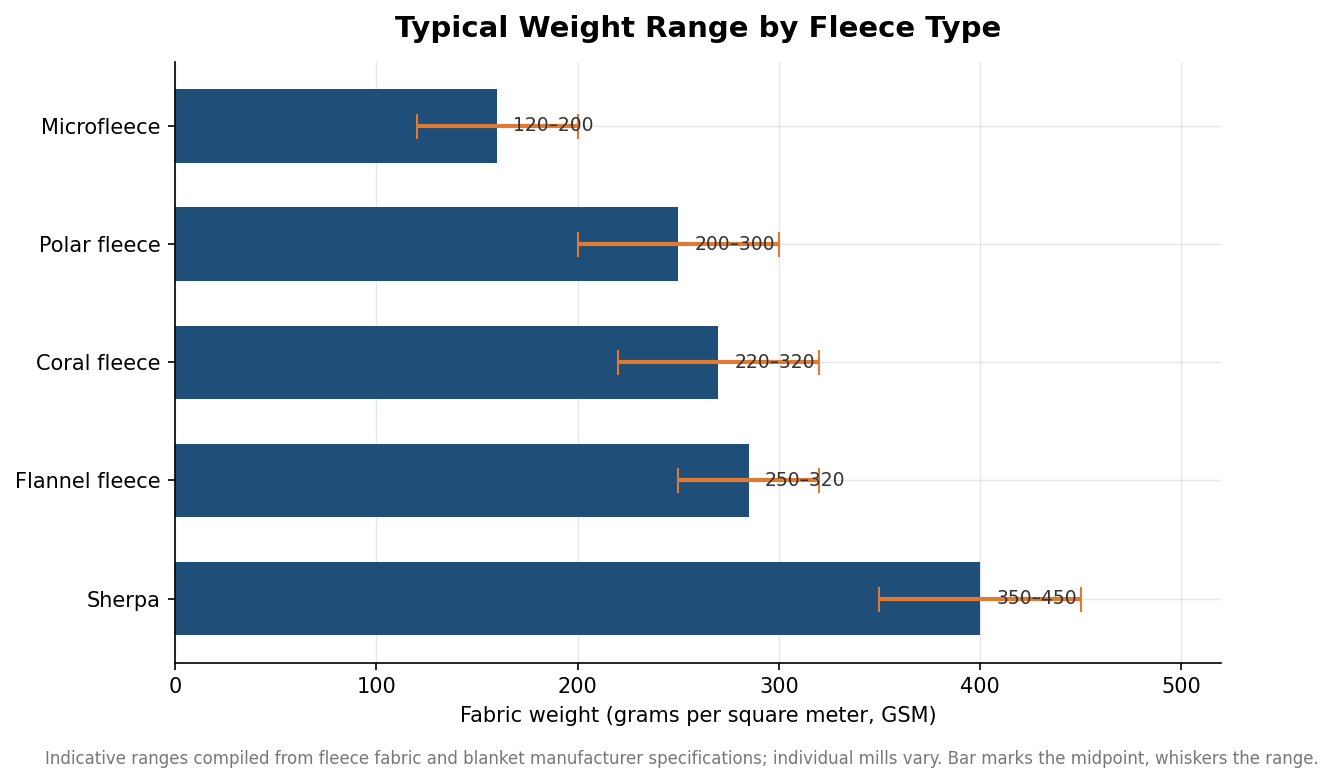
Fabric weight is measured in grams per square meter (GSM), and it does more to define a fleece blanket than the fiber name does. Lightweight fleece runs roughly 100 to 200 GSM and suits travel throws, giveaways, and warm-climate use. The 200 to 300 GSM band is the workhorse range for standard promotional and retail throws, heavy enough to feel substantial without becoming stiff. From 300 to 400 GSM you move into genuinely warm winter weights, and above 400 GSM you are into plush, thick constructions that read as premium but add real cost and shipping bulk.
Weight matters commercially because it drives two numbers at once: material cost, which scales almost linearly with GSM, and shipping, since a 400 GSM king blanket can weigh more than twice its 180 GSM lightweight equivalent. If a supplier quotes a fabric only by name, ask for the GSM before comparing prices. A quote for “polar fleece” at one price and “polar fleece” at another often comes down to a 60 or 80 GSM difference you cannot see in a photo.
Polar fleece is the practical default
Polar fleece is the fabric most custom blanket programs land on, and for good reason. It is a medium-weight, double-sided pile fabric, typically in the 200 to 300 GSM range, brushed on both faces so it feels soft top and bottom. It is warm for its weight, it is dimensionally stable enough to hold a clean hemmed edge, and it dries quickly because the polyester fibers hold little water. For most logo throws, event blankets, and retail-grade products, polar fleece is the safe center of the road.
Its other advantage is decoration. Because polar fleece is nearly always 100 percent polyester, it takes dye sublimation extremely well, which is what makes full-coverage, edge-to-edge printed designs possible. If your artwork is a large photographic or all-over pattern rather than a single-position logo, polar fleece and its cousins are usually the substrate that makes it work. The trade-off is that at higher weights polar fleece becomes noticeably less drapey, so a 300 GSM blanket feels warm but a little board-like compared with a plush alternative.
Coral and micro fleece sit at two ends of the softness scale
Coral fleece is built for a plush, indulgent hand feel. It uses a longer, looser pile than polar fleece, which is what gives it that deep, velvety surface people associate with a “luxury” throw, often in a similar 220 to 320 GSM weight band. The longer pile is also its main weakness: coral fleece tends to shed a little more in early washes and can flatten over time if it is a lower-density construction. When you are quoting coral fleece, pile density matters as much as GSM, because a dense pile is what keeps the softness from packing down.
Micro fleece is the opposite move, a thin, fine-fiber fleece usually under 200 GSM. On its own it is light and breathable rather than warm, which makes it a strong pick for summer throws, baby blankets where breathability is a selling point, and anything where packed size and low shipping weight matter. It is not the fabric to reach for if the customer’s first expectation is warmth. Think of coral and micro fleece as the plush end and the light end of the same spectrum, with polar fleece holding the middle.
Sherpa and flannel fleece are the plush, heavy end
Sherpa is a high-pile fabric that imitates the look of wool shearling, with a smooth knit back and a thick, curly face. It is almost always used as one layer of a two-sided blanket rather than on its own, commonly bonded to a polar or flannel face so you get a printable smooth side and a fluffy sherpa side. Those constructions push well past 400 GSM in combined weight, which is why sherpa blankets feel and price like premium items. They are warm and they photograph beautifully, but they are heavy to ship and slower to dry.
Flannel fleece, sometimes sold under names like velvet flannel, is a dense, short-pile fabric prized for an exceptionally smooth surface that holds printed detail crisply, typically around 250 to 320 GSM. It is a frequent partner for sherpa in double-layer blankets and a good standalone choice when a customer wants a refined, tight surface rather than a long fuzzy pile. Between these two you can build the plush, gift-grade end of a product line, as long as the budget and the box size can absorb the extra weight.
Match the fabric to the print and the job
Fabric choice and decoration method are not separate decisions. Full-bleed, all-over designs need a polyester fleece and dye sublimation, which rules sublimation in for polar, coral, micro, and flannel faces and effectively rules out a raw sherpa surface as the print side. A single-position logo, by contrast, can be embroidered or appliqued onto almost any of these, though very high-pile fabrics like sherpa and loose coral fleece can swallow fine embroidery detail, so thicker thread and simpler marks reproduce better there.
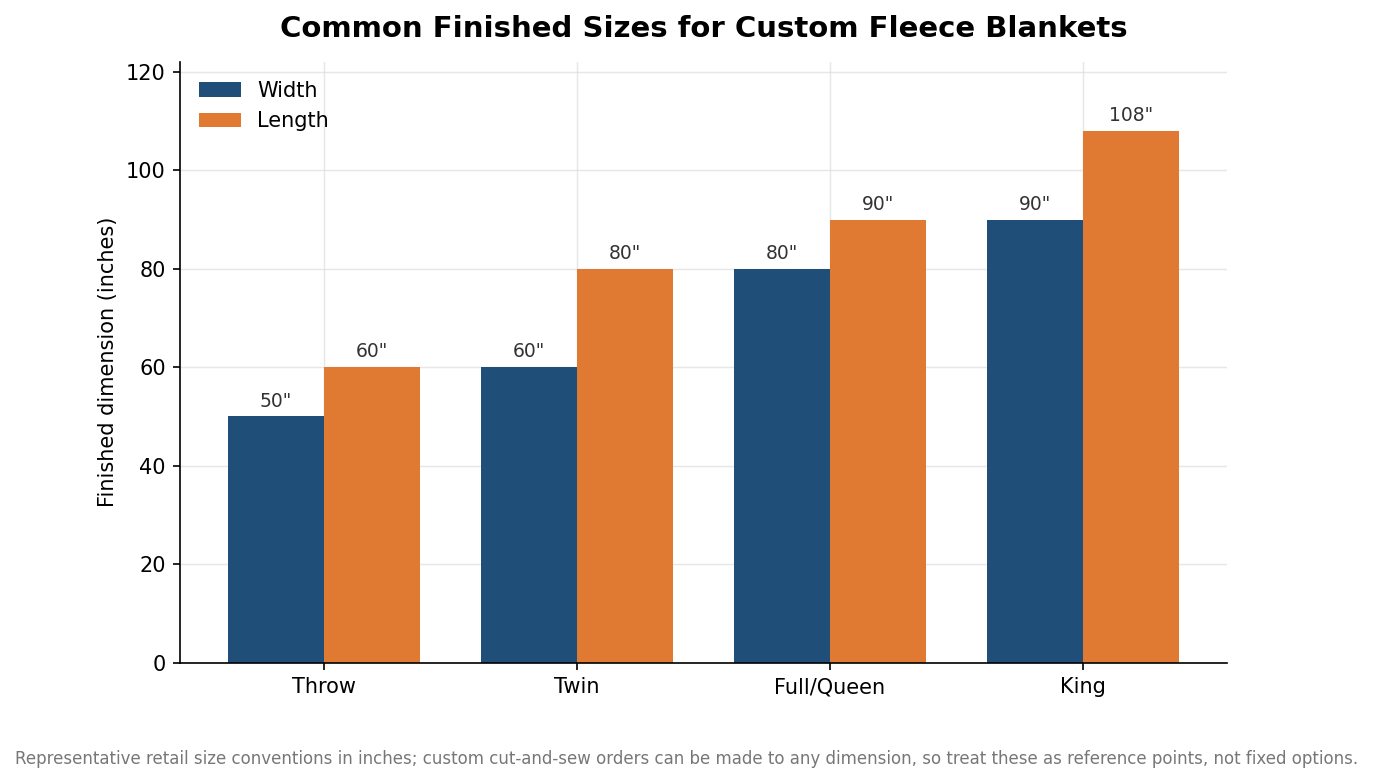
The finished size then sets how much of any fabric you are buying. Standard conventions run about 50 by 60 inches for a throw, 60 by 80 for twin, 80 by 90 for full or queen, and 90 by 108 for king, and custom cut-and-sew work can hit any dimension in between. Because material is priced by area and weight, moving from a throw to a queen in a 300 GSM fabric roughly triples the fabric cost per piece before any decoration, so it pays to confirm the size and the GSM together rather than one at a time.
The short version: decide the weight band first, since it sets warmth, cost, and shipping; then pick the fleece family for the hand feel and print you need, with polar as the reliable default, coral or micro at the plush and light extremes, and sherpa or flannel for the premium end. Ask every supplier to state the GSM and, for coral and sherpa, the pile, so you are comparing the same thing. A blanket sample in hand before a full run is still the single best insurance, because the number that ultimately matters, how the fabric feels, is the one a spec sheet can only approximate.